

Seeing wood damage or winged insects? This guide shows you exactly how to identify carpenter ants vs. termites—and what to do about each.
Why This Identification Matters (A Lot)
You spotted something alarming:
- Sawdust piles below wooden structures
- Winged insects swarming near your windows
- Hollow-sounding wood when you tap it
- Damaged wood in your deck or home
Your first thought: “Is this termites? How bad is it? How much will this cost?”
Here’s why proper identification is critical:
| Issue | Carpenter Ants | Termites |
| Damage Speed | Slow (years) | Fast (months-years) |
| Severity | Moderate | Severe |
| Treatment Cost | $200-$500 | $800-$2,500 |
| Urgency | Weeks OK | Days matter |
| Insurance | Not covered | Not covered |
Misidentifying costs you time and money. Treating for the wrong pest wastes hundreds of dollars and lets the real problem continue.
Good news: Carpenter ants and termites look VERY different once you know what to look for. This guide gives you the knowledge to identify them confidently.
Quick Visual Identification Guide
Can’t tell them apart? Start here.
The 3-Second Test
Look at the insect’s body shape:

CARPENTER ANT:
- Body has distinct “waist” (pinched middle)
- Three clear body segments (head, thorax, abdomen)
- Elbowed antennae (bent like an elbow)
- If winged: Front wings longer than back wings
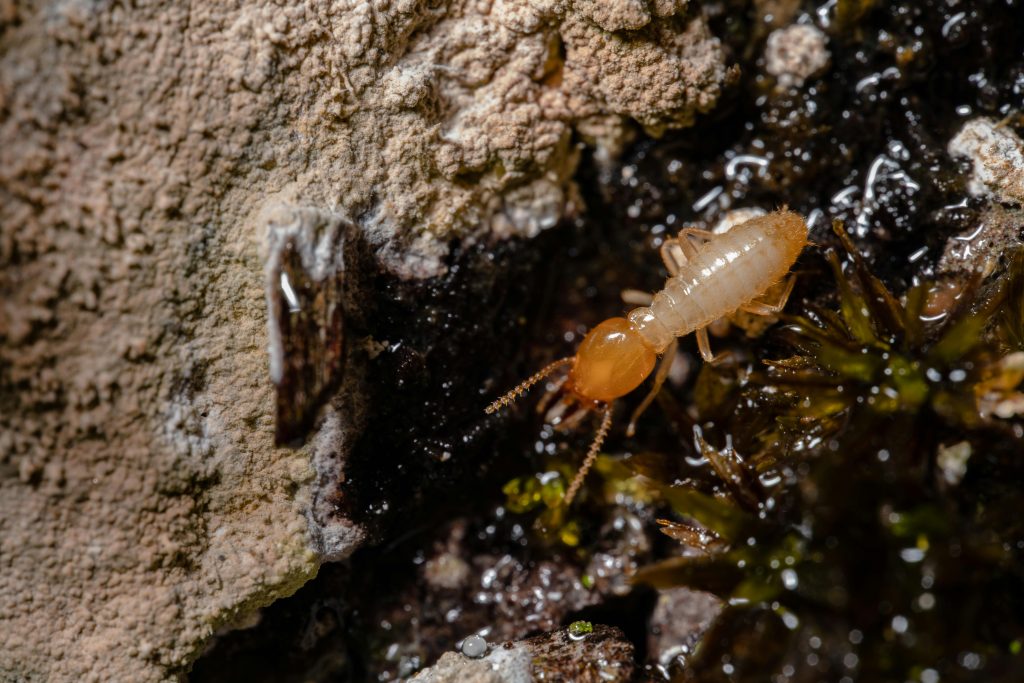
TERMITE:
- Body is straight (no waist, like a grain of rice)
- Two body segments (no distinct waist)
- Straight antennae (like tiny beads on a string)
- If winged: All four wings equal length
Still not sure? Keep reading for detailed identification…
Carpenter Ants: Complete Profile
What Are Carpenter Ants?
Scientific Name: Camponotus species (most common: Camponotus pennsylvanicus)
Size: 1/4 to 1/2 inch long (workers), up to 3/4 inch (queens)
Color: Typically black, but some species are red, brown, or combination
Habitat: Nest in wood (but don’t eat it)
Diet: Sugar, protein, honeydew from aphids (they’re scavengers, not wood-eaters)
Range: Throughout United States, especially northern states
How to Identify Carpenter Ants
Body Structure:
- Three distinct body segments
- Head (with antennae)
- Thorax (middle section with legs)
- Abdomen (rear section)
- Pinched waist between thorax and abdomen (very narrow)
- Elbowed antennae (bent at 90-degree angle)
- Six legs (three pairs)
Size Variation: Carpenter ant colonies have different castes:
- Workers (minor): 1/4 to 3/8 inch
- Workers (major): 3/8 to 1/2 inch
- Queens: 3/4 inch (much larger)
- Males: Similar to queens (winged)
Color:
- Most are solid black
- Some species are red and black (bicolored)
- Some are entirely reddish-brown
- All have smooth, shiny bodies
Movement:
- Fast moving when disturbed
- Follow trails (pheromone paths)
- Most active at night (nocturnal)
- Scout ants search for food alone
Where Carpenter Ants Nest
Primary Nests (Parent Colonies): Carpenter ants establish main nests in:
- Dead or dying trees (standing or fallen)
- Stumps and logs
- Landscape timbers and railroad ties
- Firewood piles (if stored against house)
- Utility poles (wooden)
Satellite Nests (Secondary Colonies): Once established, they create satellite nests in:
- Deck posts and railings
- Fascia boards and soffits
- Window frames and sills
- Porch columns
- Door frames
- Wall voids (if moisture present)
- Roof sheathing (if rotted)
What They Need:
- Moisture-damaged wood (essential—they rarely nest in sound wood)
- Quiet location (undisturbed)
- Access to food (sweets and protein)
- Moderate temperatures (60-90°F ideal)
Colony Size:
- Mature colonies: 3,000-50,000 ants
- Takes 3-6 years to reach maturity
- Can have multiple satellite nests connected to main colony
Signs of Carpenter Ant Infestation
1. Sawdust Piles (Called “Frass”)
- Appearance: Looks like pencil shavings or coarse sawdust
- Color: Light tan to dark brown (matches wood color)
- Texture: Rough, fibrous (wood shavings, not powder)
- Location: Below exit holes in wood
- Also contains: Insect body parts, dead ants
Why This Matters: This is the #1 sign of active carpenter ants. Termites don’t create sawdust.
2. Rustling Sounds in Walls
- When: Night (carpenter ants are nocturnal)
- Sound: Soft rustling, like crumpling cellophane
- Why: Thousands of ants moving through galleries
3. Seeing Large Black Ants
- When: Mostly evening/night
- Where: Kitchen, bathroom (searching for water/food)
- Number: Usually individuals or small groups (scouts)
- Size: Noticeably larger than pavement or odorous house ants
4. Winged Ants (Swarmers)
- When: Spring (March-May in northern states)
- Where: Near windows, light sources
- Meaning: Mature colony nearby (3+ years old)
- Number: Can be dozens to hundreds
5. Damaged Wood
- Location: Moist or previously moist areas
- Appearance: Smooth galleries (not muddy like termites)
- Structure: Clean-looking excavations
- Entry holes: Small (1/8 inch), clean edges
What Carpenter Ants Actually Do
Common Misconception: Carpenter ants eat wood.
Reality: They excavate wood to create nesting galleries but don’t digest it. They eat:
- Sugars (honeydew from aphids, nectar, sweets)
- Proteins (dead insects, meats, pet food)
- Fats (grease, oils)
How They Damage Wood:
- Excavate smooth galleries and tunnels
- Remove wood with mandibles (jaws)
- Push out sawdust through openings
- Create extensive tunnel networks
- Weaken structural wood over time
Damage Timeline:
- Year 1-2: Minimal damage, small colony
- Year 3-4: Noticeable damage, colony expanding
- Year 5+: Significant structural damage possible
- Major damage: Usually takes 5-10 years
Vs. Termites: Carpenter ants damage slower but can still compromise structures given enough time.
Termites: Complete Profile
What Are Termites?
Scientific Name: Reticulitermes species (subterranean termites, most common in northern US)
Size: 1/8 to 1/4 inch long (workers), 1/2 inch (soldiers and reproductives)
Color: Cream to white (workers), brown-black (swarmers)
Habitat: Nest underground, travel to wood food sources
Diet: Cellulose (wood, paper, cardboard)—they actually eat and digest wood
Range: Throughout US except Alaska; more common in southern states
How to Identify Termites
Body Structure:
- Straight body (no pinched waist)
- Two body segments that flow together
- Straight antennae (look like tiny beads on a string)
- Soft-bodied (translucent, almost white)
- Six legs
Castes Look Different:
Workers (Most Common):
- 1/8 to 1/4 inch
- Cream to white color
- Soft body (almost translucent)
- No wings
- Rarely seen (stay hidden in wood/soil)
Soldiers:
- Same size as workers
- Large rectangular heads
- Large mandibles (jaws)
- Defend colony
- Rarely seen above ground
Swarmers (Reproductives):
- 1/4 to 1/2 inch (including wings)
- Dark brown to black body
- Four equal-length wings
- Only caste most people see
- Emerge in spring (swarms)
Where Termites Live
Underground Colonies: Unlike carpenter ants, termites nest underground:
- Soil nests 6-12 inches below surface
- Connected to wood via mud tubes
- Moisture required (can’t survive without)
- Colony size: 60,000 to 1 million termites
How They Access Wood:
- Build mud tubes from ground to wood
- Tubes protect from air (they need moisture)
- Tubes are highways for thousands of termites
- Multiple tubes = active infestation
Wood They Target:
- Any wood-to-soil contact (deck posts, siding, firewood)
- Moist wood (leaking pipes, roof leaks)
- Structural lumber (floor joists, wall studs, foundation)
- Firewood, mulch, cardboard boxes
Signs of Termite Infestation
1. Mud Tubes on Foundation
- Appearance: Brown pencil-width tubes on concrete/brick
- Texture: Muddy, grainy (made of soil and saliva)
- Location: Foundation walls, crawl spaces, basement
- Direction: Ground to wood (vertical)
- Active: Break open tube, check for termites inside
This Is The #1 Sign: If you see mud tubes, you have termites (or recently had them).
2. Winged Termites (Swarmers)
- When: Spring (April-May in Illinois)
- Where: Near windows, doors, lights
- Number: Dozens to hundreds at once
- Behavior: Fly poorly, attracted to light
- After swarming: Shed wings in piles
3. Discarded Wings
- Location: Window sills, doors, bathtubs
- Appearance: Small translucent wings (1/2 inch)
- Number: Dozens in one spot
- Meaning: Swarm occurred recently, termites nearby
4. Wood Damage
- Hollow sound when tapped
- Blistering/darkening of wood surfaces
- Maze-like patterns inside wood
- Muddy appearance inside galleries
- Buckled wood or floors
5. Frass (Termite Droppings)
- Note: SUBTERRANEAN termites (most common in northern US) do NOT produce visible droppings
- Drywood termites (southern US, rare in Illinois) produce pellet-like frass
- If you see pellets: Likely drywood termites (different species)
What Termites Actually Do
They Eat Wood: Unlike carpenter ants, termites consume cellulose:
- Digest wood with gut bacteria
- Eat along wood grain
- Leave thin shells (wood looks intact outside)
- Hollow out interior completely
- Can destroy structural integrity
Damage Timeline:
- Year 1: Minimal visible damage
- Year 2-3: Moderate damage, structural concerns begin
- Year 4-5: Severe damage, repair costs escalate
- Major damage: Possible in 3-5 years (much faster than carpenter ants)
Average Damage: $3,000-$8,000 to repair. Severe cases exceed $20,000.
Side-by-Side Comparison: 7 Key Differences
Difference #1: Body Shape
CARPENTER ANTS:
- Pinched waist (very obvious)
- Three distinct body segments
- “Ant-shaped” (most people recognize)
TERMITES:
- Straight body (no waist)
- Uniform width from head to tail
- “Grain of rice” shape
Identification Tip: If it has a waist, it’s an ant. If straight, it’s a termite.
Difference #2: Antennae
CARPENTER ANTS:
- Elbowed (bent at 90-degree angle)
- Segmented but clearly bent
- Flexible, move independently
TERMITES:
- Straight (like beads on a string)
- Segmented but no bends
- Look like tiny strings with bumps
Identification Tip: Look at antenna shape first, it’s one of the easiest tells.
Difference #3: Wings (If Present)
CARPENTER ANT SWARMERS:
- Front wings much longer than back wings
- Four total wings
- Wings proportionate to body
- Wings lie flat when at rest
TERMITE SWARMERS:
- All four wings identical length
- Look like two long oars
- Wings much longer than body (2x body length)
- Wings held above body at rest
Identification Tip: If wings are equal length and very long, it’s definitely a termite.
Difference #4: Color
CARPENTER ANTS:
- Usually black (most common)
- Some species red, brown, or bicolored
- Shiny appearance
- Workers and soldiers same color
TERMITES:
- Workers: Cream to translucent white
- Soldiers: Cream with brown heads
- Swarmers: Dark brown to black
- Dull appearance (not shiny)
Identification Tip: If you’re seeing cream-colored soft insects in wood, that’s termites. Black or red shiny insects with defined waists are carpenter ants.
Difference #5: Where You Find Them
CARPENTER ANTS:
- Visible on surfaces (foraging for food)
- Trails on sidewalks, decks, walls
- In kitchens and bathrooms (seeking moisture)
- Active at night
- Individual scouts common
TERMITES:
- Rarely seen (stay hidden)
- Only see swarmers (once per year)
- Workers stay in wood/mud tubes
- Never see them casually foraging
- If you see them, usually in dozens/hundreds
Identification Tip: If you’re seeing individual large ants walking around, it’s carpenter ants. If you break open wood and find dozens of cream-colored insects, it’s termites.
Difference #6: What They Leave Behind
CARPENTER ANTS:
- Sawdust piles (frass) below infested wood
- Clean galleries (smooth excavated tunnels)
- No mud inside wood
- Exit holes (small, clean)
- No tubes on walls
TERMITES:
- Mud tubes on foundation/walls
- Muddy galleries inside wood
- No sawdust (they eat the wood)
- Discarded wings in piles
- Hollow wood (tap sounds hollow)
Identification Tip: Sawdust = carpenter ants. Mud tubes = termites. Both = you have both pests (rare but possible).
Difference #7: Damage Speed & Severity
CARPENTER ANTS:
- Slow damage: 5-10 years for serious structural issues
- Moderate severity: Usually cosmetic for years
- Localized: Focus on moist/damaged wood first
- Visible warning signs: Sawdust appears before major damage
TERMITES:
- Fast damage: 3-5 years for structural concerns
- Severe: Can compromise structural integrity
- Widespread: Entire foundation can be infested
- Hidden damage: May not see signs until severe
Identification Tip: If you’re seeing damage but it’s been slow (years), likely carpenter ants. If damage appeared quickly (caught you by surprise), more likely termites.
Damage Comparison: What Each Pest Leaves Behind
Carpenter Ant Damage
Visual Characteristics:
- Smooth, clean galleries
- Look like someone carved them
- No mud or dirt inside
- Wood shavings pushed out (not inside tunnels)
- Sawdust piles below damaged areas
- Coarse texture (not powder)
- Mixed with insect parts
- Fibrous appearance
- Small exit holes
- About 1/8 inch diameter
- Smooth, clean edges
- Sawdust piles below holes
- Galleries follow wood grain
- Logical pattern
- Efficient excavation
- Structural wood weakened but not consumed
Where Damage Occurs:
- Moist or previously moist wood
- Areas with prior water damage
- Wood touching soil (deck posts)
- Fascia boards behind clogged gutters
- Window sills with leaks
Severity:
- Minor: Surface damage, cosmetic
- Moderate: Galleries in non-structural wood (trim, siding)
- Severe: Structural members compromised (beams, joists)
Timeline to Severe Damage: Usually 7-10 years
Termite Damage
Visual Characteristics:
- Muddy, dirty galleries
- Filled with mud-like substance
- Soil mixed with wood particles
- Looks messy (not clean like carpenter ant galleries)
- Honeycomb pattern
- Maze-like appearance
- Follows wood grain
- Leaves thin shell (outside looks fine)
- No sawdust
- Wood is consumed (eaten), not excavated
- Galleries are eaten spaces, not carved tunnels
- Mud tubes on foundation
- Pencil-width tubes from ground to wood
- Made of soil, saliva, and feces
- Termite highway (protected from air)
Where Damage Occurs:
- Any wood touching soil (direct contact)
- Structural wood (sills, joists, studs, rafters)
- Flooring (especially near moisture)
- Wooden supports in basements/crawl spaces
- Behind walls (you don’t see until severe)
Severity:
- Minor: Limited to small area, caught early
- Moderate: Multiple joists/studs affected
- Severe: Structural integrity compromised, floors sagging
Timeline to Severe Damage: Can occur in 3-5 years
Comparison Photos/Descriptions
CARPENTER ANT DAMAGE:
[Imagine Photo: Clean, smooth galleries carved through wood]
– Smooth surfaces inside tunnels
– Sawdust pile below small exit hole
– Wood appears carved/excavated
– No muddy residue
TERMITE DAMAGE:
[Imagine Photo: Muddy, honeycomb-pattern galleries]
– Mud coating inside damaged areas
– Honeycomb maze pattern
– Wood shell intact but interior hollowed
– Mud tube visible connecting ground to wood
Side-by-Side:
| Feature | Carpenter Ants | Termites |
| Gallery appearance | Clean, smooth | Muddy, dirty |
| Sawdust | Yes (piles outside) | No |
| Mud tubes | No | Yes (on walls) |
| Pattern | Smooth tunnels | Honeycomb maze |
| Speed | Slow (years) | Fast (months-years) |
| Structural risk | Moderate | High |
Swarmers: Flying Ants vs. Flying Termites
Spring panic: You see winged insects emerging from your home. Are they ants or termites?
When Swarms Happen
Carpenter Ant Swarms:
- Season: Spring (March-May in northern states)
- Trigger: Warm weather after winter
- Time: Late afternoon/evening
- Location: Mature colonies (3+ years old)
- Frequency: Once per year
Termite Swarms:
- Season: Spring (April-May in Illinois)
- Trigger: Warm, humid days after rain
- Time: Midday to afternoon
- Location: Established colonies (3+ years)
- Frequency: Once per year (massive event)
How to Tell Them Apart
CARPENTER ANT SWARMERS:
- Body: Pinched waist (ant-shaped)
- Wings: Front pair longer than back pair
- Antennae: Elbowed
- Color: Black or reddish-black
- Size: 1/2 to 3/4 inch (including wings)
- Flight: Strong fliers, disperse widely
- After: Shed wings, disappear individually
TERMITE SWARMERS:
- Body: Straight (no waist, cylindrical)
- Wings: All four equal length (like paddles)
- Antennae: Straight (beaded)
- Color: Dark brown to black
- Size: 1/4 to 1/2 inch (but wings make them look bigger)
- Flight: Poor fliers, clumsy, attracted to light
- After: Shed wings in piles, pair off
What Swarms Mean
If You See Carpenter Ant Swarmers:
- Mature colony nearby (within 100 yards)
- Could be in your home, or neighbor’s property, or tree
- Indicates 3+ year old colony
- Time to inspect and treat
If You See Termite Swarmers:
- Established colony present (in ground, under/in home)
- Colony is 3-4 years old, large (thousands of termites)
- High likelihood of structural damage already present
- Immediate professional inspection needed
Both:
- Swarmers themselves don’t cause damage (they’re reproductives leaving to start new colonies)
- Presence indicates mature infestation needs treatment
- Don’t ignore—address immediately
What to Do If You See a Swarm
Immediate Action:
- Try to capture specimens (in jar or bag)
- Note location where they emerged
- Photograph if possible (for identification)
- Check for more the next few days
Identification:
- Look at wings (equal length = termites)
- Look at body (waist = ants)
- Look at antennae (bent = ants, straight = termites)
Next Steps:
- Schedule professional inspection (don’t wait weeks)
- Inspect area where swarmers emerged
- Look for other signs (mud tubes for termites, sawdust for ants)
Geographic Risk: Which Is More Common in Your Area?
Chicagoland and Northern Illinois
CARPENTER ANTS:
- ⚠️ Very Common (high risk)
- Thrive in northern climates
- Love mature trees (common in established suburbs)
- Active May-October
- Winter dormant (but can be active indoors)
High-Risk Areas:
- Palatine – Mature trees, Deer Grove Forest Preserve
- Glenview – Wooded North Shore properties
- Any established suburb with 50+ year old trees
TERMITES:
- ⚠️ Moderate Risk
- Eastern subterranean termites present
- Less common than southern states
- Active April-October
- Risk increases with:
- Crawl space homes
- Wood-to-soil contact
- Moisture problems
Geographic Note:
- Southern US: Termites much more common (severe risk)
- Northern US: Carpenter ants more common
- Both possible anywhere, but prevalence varies
What to Do If You Have Carpenter Ants
Step 1: Confirm Identification
Before treating, verify it’s actually carpenter ants:
- Look for sawdust piles
- Check for large black ants (not small brown ones)
- Look for ants with pinched waists
- Note if activity is in/near moist wood
Step 2: Locate the Nest
Exterior Inspection:
- Check trees within 100 yards (especially dead/dying)
- Inspect stumps and logs
- Check firewood piles
- Look at deck posts and railings
- Examine fascia boards (especially behind gutters)
Interior Inspection:
- Look for sawdust below exit holes
- Listen for rustling sounds at night
- Check moisture-damaged areas (bathrooms, kitchens)
- Inspect window sills and door frames
Step 3: Treatment Options
DIY Treatment (Minor Infestations):
Baiting:
- Use liquid or gel baits (worker ants carry to nest)
- Place baits along trails
- Takes 7-14 days to work
- Best for small infestations
Spray Treatments:
- Non-repellent sprays (Termidor, Phantom)
- Apply to trails and entry points
- Ants track through treatment, carry to nest
- More effective than repellent sprays
Limitations:
- Hard to reach nests (often in walls or trees)
- Requires finding primary nest
- May only treat satellite nests (problem returns)
Professional Treatment (Moderate to Severe):
What Pros Do:
- Comprehensive inspection (find all nests)
- Direct nest treatment (dust or liquid injected into galleries)
- Perimeter treatments (prevent new entry)
- Tree treatments (eliminate parent colonies in trees)
- Follow-up (ensure complete elimination)
Why It Works Better:
- Professionals know where to look
- Access to stronger products
- Treat parent AND satellite nests
- Warranty ensures effectiveness
Cost: $250-$500 typically
Timeline: 2-3 visits over 3-6 weeks for complete elimination
Step 4: Prevent Recurrence
Fix Moisture Issues:
- Repair leaky roofs and gutters
- Fix plumbing leaks
- Improve ventilation in damp areas
- Remove water-damaged wood
Eliminate Nesting Sites:
- Remove dead trees (or treat if you want to keep)
- Replace rotted fascia boards
- Fix rotted deck posts
- Remove stumps near home
Reduce Attractants:
- Keep food sealed
- Don’t leave pet food out
- Clean up spills promptly
- Store firewood away from house (20+ feet)
Trim Trees:
- Keep branches from touching roof
- Maintain 6-foot clearance
- Reduces access routes
What to Do If You Have Termites
Step 1: Confirm Identification
Verify termites before expensive treatment:
- Look for mud tubes on foundation
- Check if insects have straight bodies (no waist)
- Look for discarded wings
- Break open suspected wood (look for muddy galleries)
- If unsure, capture specimen for pro identification
Step 2: Professional Inspection (Required)
DIY termite treatment is NOT recommended. Here’s why:
- Termites nest underground (you can’t reach them)
- Colonies are huge (60,000+ termites)
- Damage is structural (too risky for amateur treatment)
- Treatment requires specialized equipment
- Misapplication wastes money and time
Professional Inspection Includes:
- Complete home inspection (interior and exterior)
- Foundation examination (mud tubes, cracks)
- Crawl space inspection
- Detection of moisture issues
- Damage assessment
- Treatment recommendation
Cost: Usually free or $50-150 (often applied to treatment if you proceed)
Step 3: Treatment Options
Option 1: Liquid Barrier Treatment
How It Works:
- Trench around home perimeter
- Apply liquid termiticide to soil
- Creates treated zone (barrier)
- Termites die when crossing treated soil
- Lasts 5+ years
Pros:
- Immediate protection
- Long-lasting (5-10 years)
- Proven effective
- Good for active infestations
Cons:
- Disruptive (trenching required)
- Affects landscaping temporarily
- Uses chemical treatment
- Upfront cost higher
Cost: $1,200-$2,500 (average home)
Option 2: Baiting Systems (Recommended for Chicagoland)
How It Works:
- Bait stations installed around perimeter
- Stations monitored regularly
- When termites found, bait activated
- Termites eat bait, carry to colony
- Colony eliminated (including queen)
Most Common: Trelona ATBS, Sentricon
Pros:
- Minimal disruption (small stations installed)
- Eliminates entire colony
- Environmentally friendly
- Annual monitoring included
- Transferable warranty (good for home sale)
Cons:
- Takes longer (2-4 months to eliminate colony)
- Requires ongoing monitoring (annual visits)
- Slightly higher long-term cost (monitoring fees)
Cost: $800-$1,500 installation + $200-350/year monitoring
Why We Recommend Baiting:
- Proven highly effective
- Less invasive for your property
- Better for environment
- Warranty protects your investment
Option 3: Fumigation
Only For: Drywood termites (rare in Illinois)
- Not used for subterranean termites
- Requires tenting entire structure
- Extremely expensive ($2,000-$8,000+)
- Not relevant for most Chicagoland homeowners
Step 4: Ongoing Monitoring
After Treatment:
- Annual inspections (included with baiting systems)
- Monitor for new mud tubes
- Check for new swarms
- Maintain moisture control
- Keep records (for warranty and home sale)
Prevention:
- Eliminate wood-to-soil contact
- Fix moisture issues (leaky pipes, poor drainage)
- Keep mulch away from foundation (6+ inches)
- Remove stumps and wood debris near home
- Annual professional inspection
Prevention Strategies for Both
Many prevention strategies work for both carpenter ants and termites:
1. Moisture Control (Critical for Both)
Why: Both pests prefer moist/damaged wood
Actions:
- Fix leaky roofs immediately
- Repair leaking pipes and faucets
- Improve drainage around foundation
- Use dehumidifiers in damp basements
- Ensure crawl spaces are ventilated
- Clean gutters regularly
- Grade soil away from foundation
2. Eliminate Wood-to-Soil Contact
Why: Direct path for termites, attractive nesting for carpenter ants
Actions:
- Keep mulch 6+ inches from foundation
- Remove wood debris from property (old lumber, logs)
- Replace rotted deck posts with concrete footers or treated lumber
- Don’t bury wood landscaping timbers
- Store firewood on racks, away from house (20+ feet)
3. Seal Entry Points
Why: Prevents both from accessing your home
Actions:
- Seal cracks in foundation
- Caulk gaps around windows and doors
- Fill utility penetrations (pipes, wires)
- Repair damaged siding
- Screen crawl space vents (1/4 inch mesh)
4. Maintain Your Property
Why: Reduces harborage and nesting sites
Actions:
- Trim trees away from house (6+ foot clearance)
- Remove dead trees and stumps
- Replace rotted wood promptly
- Keep attic and crawl spaces dry
- Repair damaged fascia and soffits
5. Annual Inspections
Why: Catch problems early (before major damage)
Schedule:
- Professional inspection every 1-2 years
- Self-inspection quarterly (look for signs)
- Immediate inspection if you see swarmers
What to Check:
- Foundation for mud tubes
- Wood for damage or sawdust
- Moisture issues (leaks, condensation)
- Trees for carpenter ant activity
When to Call a Professional
Call Immediately If:
1. You See Termite Mud Tubes
- Indicates active or recent termite infestation
- Professional treatment required
- DIY is not effective for termites
- Structural damage may already exist
2. You See Termite Swarmers
- Means established colony (3+ years old)
- Immediate inspection needed
- Treatment should begin ASAP
- Don’t wait weeks or months
3. You Find Extensive Carpenter Ant Damage
- Sawdust piles in multiple locations
- Structural wood compromised
- Large colonies (thousands of ants)
- Nests difficult to locate
4. DIY Treatment Failed
- Tried baits/sprays, ants persist
- Problem keeps returning
- Multiple nests suspected
- Can’t find primary nest
5. You’re Unsure Which Pest You Have
- Free or low-cost identification
- Prevents wasting money on wrong treatment
- Professionals identify instantly
Professional Inspection Includes:
Carpenter Ants:
- Property inspection (trees, structures)
- Moisture assessment
- Nest location (primary and satellites)
- Treatment plan with costs
- Prevention recommendations
Termites:
- Complete structural inspection
- Foundation examination
- Crawl space assessment
- Damage evaluation
- Treatment options with warranty
Cost:
- Carpenter ants: $100-200 (often free with treatment)
- Termites: Free to $150 (usually credited toward treatment)
Frequently Asked Questions
Q: Can I have both carpenter ants AND termites? A: Yes, but it’s uncommon. Both are attracted to moisture-damaged wood. If you suspect both, professional inspection is critical.
Q: Are carpenter ants as bad as termites? A: No. Carpenter ants damage slower and cause less structural concern. However, both should be treated promptly to prevent damage.
Q: How much damage can carpenter ants cause? A: Over 5-10 years, significant structural damage is possible. Most homeowners catch them before reaching this point.
Q: How much damage can termites cause? A: Average repair cost is $3,000-$8,000. Severe cases exceed $20,000. They can compromise structural integrity in 3-5 years.
Q: Does homeowner’s insurance cover carpenter ant or termite damage? A: No. Both are considered preventable maintenance issues. You pay for all damage and treatment.
Q: If I see one carpenter ant, do I have an infestation? A: Not necessarily. Scouts wander far from nests. If you see them regularly (especially large black ants), inspection is warranted.
Q: If I see one termite, is that bad? A: Yes. Individual termites rarely appear alone. One termite usually indicates a nearby colony. Inspect immediately.
Q: What time of year should I worry about these pests? A: Carpenter ants: Active spring-fall (May-October), dormant winter (but can be active indoors) Termites: Active spring-fall (April-October), swarm April-May
Q: Can carpenter ants fly? A: Reproductive carpenter ants (swarmers) have wings and fly. Workers (most common) do not.
Q: Can termites fly? A: Reproductive termites (swarmers) fly poorly. Workers (underground) never have wings.
Q: How do I know if wood damage is old or active? A: Active carpenter ants: Fresh sawdust, live ants present Active termites: Mud tubes, soft wood, visible termites when broken open Old damage: Dry, no sawdust, no insects, no mud tubes
Q: Should I remove dead trees on my property? A: Yes, especially within 100 yards of home. Dead trees host carpenter ant colonies that can spread to your house.
Q: Will treated lumber prevent termites? A: Pressure-treated lumber resists termites but isn’t foolproof. Still need barrier treatment or monitoring.
Q: Can I treat carpenter ants myself? A: Minor infestations, yes. Moderate to severe infestations, professional treatment is more effective and cost-efficient.
Q: Can I treat termites myself? A: No. DIY termite treatment is ineffective and wastes money. Colonies are underground, require specialized treatment.
Conclusion: Know Your Enemy, Protect Your Home
Quick Identification Summary:
If you see:
- Large black ants with pinched waists → Carpenter ants
- Cream-colored soft insects in wood → Termites (workers)
- Mud tubes on foundation → Termites (definitely)
- Sawdust piles below wood → Carpenter ants
- Winged insects with equal-length wings → Termites
- Winged insects with unequal wings → Carpenter ants
Urgency:
- Termites: Act within days (schedule inspection ASAP)
- Carpenter Ants: Act within weeks (inspection and treatment)
Treatment:
- Termites: Always professional (DIY doesn’t work)
- Carpenter Ants: DIY possible for minor issues, professional for moderate-severe
Cost:
- Carpenter ants: $250-$500 professional treatment
- Termites: $800-$2,500 professional treatment
Prevention:
- Control moisture (both love damp wood)
- Eliminate wood-to-soil contact
- Maintain property (remove dead trees, fix leaks)
- Annual inspections
Need Expert Help? We’re Here.
If you’ve identified carpenter ants or termites and need professional treatment, Midwest Pest Solutions provides comprehensive pest control throughout Chicagoland.
Carpenter Ant Services:
- Complete property inspection
- Tree and structure treatment
- Multi-visit programs for elimination
- Prevention recommendations
- 90-day warranty
Termite Services:
- Free comprehensive inspection
- Trelona ATBS baiting systems (recommended)
- Liquid barrier treatments
- Annual monitoring
- Transferable warranty (adds value to your home)
Service Areas:
- Palatine – High carpenter ant activity from mature trees
- Glenview – Carpenter ants in wooded North Shore properties
- Hoffman Estates – Termite monitoring near prairies
- Hanover Park – Ant control in townhomes
- Calumet City – Termite prevention near river areas
- 50+ other Chicago suburbs
📞 Call 708-439-1324 for free carpenter ant/termite identification and quote
💬 Text photos to 708-439-1324 for quick identification
🌐 Book online for fastest scheduling
Same-day inspections available | No obligation | Free identification
Don’t wait. Whether it’s carpenter ants or termites, early detection and treatment saves you thousands in damage costs. Get identified, get treated, get protected.